The Oldest Question & the American Answer

By Kathryn van der Pol

Author's note: I just finished my first book titled Liberty & Virtue! You can find it on Amazon.
“We hold these truths to be self-evident, that all men are created equal, that they are endowed by their Creator with certain unalienable rights, that among these are Life, Liberty, and the Pursuit of Happiness.” [1]
In my most recent essay, I described a precious Greek papyrus fragment. Called P52, it is the oldest known “shard” of the New Testament. By miraculous discovery, this tiny papyrus measuring only 3.5” x 2.5 “ managed to preserve the single most important question ever asked, “What is truth?”
That question, “What is truth?” is the key question that drives all religious belief and philosophy. Pursuing the trail of “What is truth?” can either advance us upon a noble adventurous quest – or force us into retreat, just like it did Pontius Pilate. And, as the life of Pontius Pilate showed, our choices can have dire consequences. To read my essay about P52, click here.
But some men and women have had the courage to attempt to live out their lives in pursuit of truth.
For example, “to bear witness to the truth” propelled the Puritans to settle in America where they built a “shining city on a hill” aspiring to build a life upon the truth of Christ.
Their descendants continued that noble quest to find their answer to this ancient question. Two hundred and fifty years ago this month, fifty-six men answered it with the Declaration of Independence. They signed their names proclaiming, “with a firm reliance on the protection of divine Providence, we mutually pledge to each other our Lives, our Fortunes and our sacred Honor.”
They knew why they were born. They understood their purpose. They believed the scripture, “You will Know the truth and the truth will set you free.” They believed truth existed, and that Jesus was the most sublime example of a virtuous life. They believed when Jesus quoted from Isaiah 61, “to proclaim freedom for the captives” (Luke 4:18) that through faith in Jesus, believers are no longer in bondage to sin and can receive righteousness and eternal life.
They also believed that rulers disobedient to God must not be obeyed. “Sic semper tyrannis” (the motto of Virginia). They believed in the words of the Harvard trained Boston Reverend, Jonathan Mayhew who preached, “Disobedience to tyrants was obedience to God.” Ben Franklin designed an early draft of the Great Seal of the United States with these very words. These men believed that obedience to government as stated in Romans 13 applied to God-fearing just rulers, not tyrannical kings. [2][3][4]
They believed that Liberty was worth defending because it was a gift of God. Christ had said so. A Christ-centered life was a virtuous life that resulted in happiness and true liberty. This is the truth.
Our founders said repeatedly they believed in the experiment of self-government, which was made possible because the society in which they lived cultivated self-discipline; the public sentiment publicly proclaimed its obedience to God. Their confidence stemmed from their faith and understanding of Scripture which inspired them to the cause of independence and establishing a land where Men may of right ought to be free from tyrannical rule. Our founders argued that Men possessed God-given gifts of reason and right of conscience, therefore the free will to choose. Men could chart their course in pursuit of happiness.
When Jefferson wrote the word “happiness” in the Declaration, he was not using the modern definition of a feeling of pleasure or emotional state of mind, but the classical sense of the word which is what he had studied in school. The Greek philosophers defined this type of happiness as Eudaimonia, which means "human flourishing." This was how Jefferson defined happiness.
We know this from a letter dating to 1819. Jefferson wrote to William Short about Epicurus, one of his favorite philosophers. At the end, he outlined for him an entire syllabus of Epicurus's key teachings. Jefferson wrote, “Virtue was the foundation of genuine happiness.” He listed the cardinal virtues—prudence, temperance, fortitude, and justice—as essential to an enlightened life. This accords well not only with Epicurus, but also with the ideas of Aristotle who wrote, “Happiness was an activity of the soul in accordance with virtue.” Although Jefferson did not write much about Aristotle, he would have known of him and about his teachings. Both Epicurus and Aristotle believed that the chief goal of life was eudaimonia, “human flourishing.” [5][6]
In another letter dating to June 26, 1822 to Dr. Benjamin Waterhouse, Jefferson expounded again upon his views of happiness. He wrote, “The doctrines of Jesus are simple, and tend all to the happiness of man.” Jefferson linked happiness to moral virtue based upon the life and teachings of Christ. This state of mind, an American mind, the rightly ordered individual, produced blessings, and fulfilled the greatest commandment which is to love God and to love our neighbor. A community of such people would work for the common good, a phrase seldom heard but sorely needed in our modern lexicon. [7]

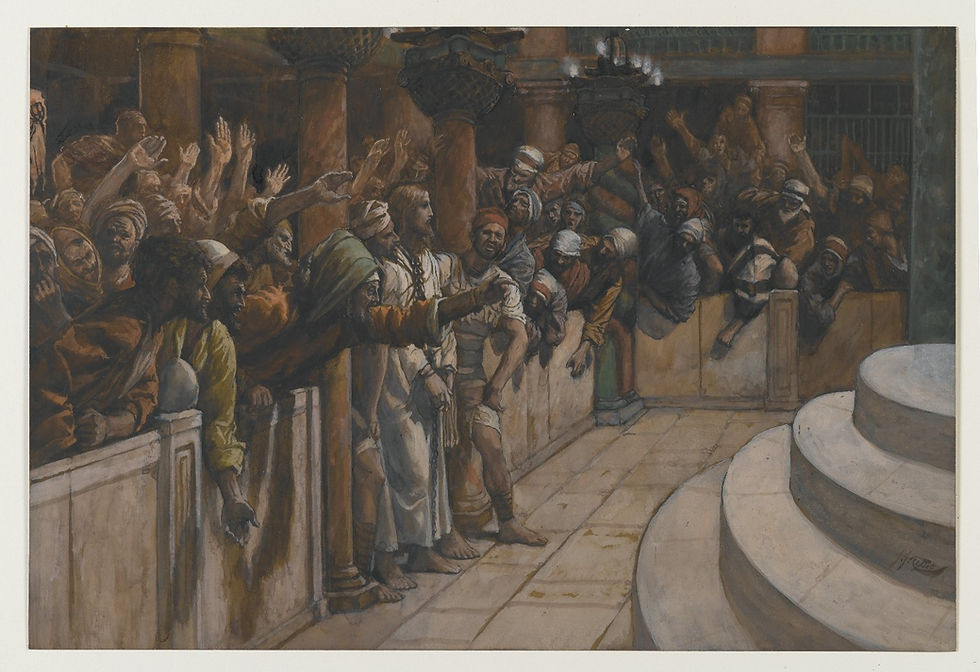
But not everyone had the courage to face that question. Pontius Pilate said, “I find no fault in him. I will have nothing to do with this.” And he washes his hands of the whole situation. Pilate cannot stand up to the crowd. He lacks prudence, justice, fortitude, and temperance. There is no framework of virtue for Pilate to lean upon. His only quest is for power.
P52 preserves the moment that Truth spoke to Power—and Power flinched.
Returning to the 1760s, British colonists were not just protesting unjust taxes but making a philosophical claim that denying their God-given rights was wrong; that the King became a tyrant when his “laws” were not based on moral principle. They went further to assert a moral imperative to resist the tyrant. They’d inherited a tradition rooted in the Bible and preserved in that tiny P52 text that truth is knowable, that truth is found in the Bible and that truth grounds the soul in virtue and develops moral character. Therefore, when society cultivates virtue in its laws and its people, the result is true liberty.
One living symbol of liberty found in the 1760s was the Liberty tree. Just as P52 is a small physical artifact that tells an enormous story, the Liberty Tree was a living symbol that told the story of a people who believed liberty and virtue were inseparable. One tree in Boston became a movement of resistance that led to hundreds of Liberty Trees across thirteen colonies—not unlike the gospels and epistles became thousands of manuscripts across the Roman world.
The Chappell Hill Chamber of Commerce, thanks to Trees for Houston, gave away 250 Liberty trees earlier this month to the children attending our Independence Day parade. What better way to celebrate our 250th anniversary with a living symbol that can live another hundred years and pass on to our future generations that love for liberty?
Two years before Jefferson wrote the Declaration of Independence, he had written a petition directed at the King of Great Britain. The King never received it. While Jefferson was selected as a delegate to the Virginia Convention in 1774, he fell ill with dysentery and could not make the trip. His friends later published the petition as a pamphlet titled, A Summary View of the Rights of British America. The pamphlet was distributed broadly in America and in Britain, and, according to Jefferson in a bit of black humor, “procured me the honor of having my name inserted in a long list” of traitors in a bill of attainder that guaranteed [my] execution. [8]
Here is part of what he wrote,
To King George,
“There are extraordinary situations which require extraordinary interposition. Exasperated people, who feel that they possess power, are not easily restrained within limits strictly regular.”
Jefferson concluded:
The God who gave us life gave us liberty at the same time; the hand of force may destroy but cannot disjoin them. This, sire, is our last, our determined resolution; and that you will be pleased to interpose with that efficacy which your earnest endeavours may ensure to procure redress of these our great grievances, to quiet the minds of your subjects in British America, against any apprehensions of future encroachment, to establish fraternal love and harmony throughout the whole empire, and that these may continue to the latest ages of time, is the fervent prayer of all British America!
Jefferson was not alone in this sentiment. Benjamin Franklin had also echoed many of Jefferson’s arguments and shared Jefferson’s view of happiness. So much so that Franklin embarked on a self-improvement plan. He planned to author a book about true happiness. He even had the title ready! He was going to call it The Art of Virtue. He detailed his methods in his Autobiography, originally written as a letter to his son. [11]
In his first inaugural address as president in March 1801, Jefferson himself explained what he meant by pursuit of happiness as it related to the role of: “A wise and frugal Government, which shall restrain men from injuring one another, shall leave them otherwise free to regulate their own pursuits of industry and improvement, and shall not take from the mouth of labor the bread it has earned. This is the sum of good government, and this is necessary to close the circle of our felicities”. [9]
In the last year of his life, Jefferson explained to Henry Lee what the Declaration of Independence was supposed to do.
When forced, therefore, to resort to arms for redress, an appeal to the tribunal of the world was deemed proper for our justification. This was the object of the Declaration of Independence. Not to find out new principles, or new arguments, never before thought of, not merely to say things which had never been said before; but to place before mankind the common sense of the subject, in terms so plain and firm as to command their assent, and to justify ourselves in the independent stand we are compelled to take. Neither aiming at originality of principle or sentiment, nor yet copied from any particular and previous writing, it was intended to be an expression of the American mind, and to give to that expression the proper tone and spirit called for by the occasion. All its authority rests then on the harmonizing sentiments of the day, whether expressed in conversation, in letters, printed essays, or in the elementary books of public right, as Aristotle, Cicero, Locke, Sidney, etc. [10]
So, Jefferson coined the phrase the American Mind and by so doing defined the common sense of the matter. He was simply applying what he had learned from his study of the Bible, the classical and Enlightenment authors to answer Pilate’s question, “What is truth?”
To tell this story about the tree, its connection to the American Mind, and the self-improvement method envisioned by Ben Franklin that you can use today, click here. Franklin never finished his Art of Virtue. But what if someone did?

End Notes
[1] The Declaration of Independence, July 4, 1776. National Archives: https://www.archives.gov/founding-docs/declaration-transcript
[2] John 8:32; Luke 4:18 / Isaiah 61:1.
[3] Jonathan Mayhew, A Discourse Concerning Unlimited Submission and Non-Resistance to the Higher Powers (Boston, 1750). Teaching American History. https://teachingamericanhistory.org/document/discourse-concerning-unlimited-submission-and-non-resistance-to-the-higher-powers/
[4] Romans 13:1–7.
[5] Thomas Jefferson to William Short, October 31, 1819. Founders Online, National Archives: https://founders.archives.gov/documents/Jefferson/03-15-02-0141-0002
[6] Aristotle, Nicomachean Ethics, Book I. MIT Classics: https://classics.mit.edu/Aristotle/nicomachae.1.i.html
[7] Thomas Jefferson to Dr. Benjamin Waterhouse, June 26, 1822. Founders Online, National Archives: https://founders.archives.gov/documents/Jefferson/03-18-02-0437
[8] Thomas Jefferson, A Summary View of the Rights of British America (1774). Avalon Project, Yale Law School: https://avalon.law.yale.edu/18th_century/jeffsumm.asp
[9] Thomas Jefferson, First Inaugural Address, March 4, 1801. Avalon Project, Yale Law School: https://avalon.law.yale.edu/19th_century/jefinau1.asp
[10] Thomas Jefferson to Henry Lee, May 8, 1825. Jefferson: Writings, ed. Merrill D. Peterson (Library of America, 1984), 1501.
[11] Benjamin Franklin, The Autobiography of Benjamin Franklin. Gutenberg: https://www.gutenberg.org/ebooks/20203