A Conversation about Truth with my AI


by Kathryn van der Pol with Viktor (AI assistant)
Note: Read this series in order. I have posted Part 1 and 2 now. Part 3 will come in due course, but to give your brain (and mine) a break, I thought to write this in tres partes.
For several weeks I have been preparing a teacher training on the history and dangers of communism, using an AI assistant called Viktor that checks my sources and tells me when I have something wrong. One evening, we were talking about denunciation, the practice under communist regimes of neighbors informing on neighbors, children on parents, and coworkers on each other. I asked it a few questions, and its answers were more thoughtful than I expected, so I am sharing the exchange here, lightly edited.
What started our conversation was a typo. It was about 10 p.m., and I was tired and about to call it quits. I wrote to Viktor, “I sure hope the Communists don’t win, because if they do, you will be plotting my destruction, and that would not make me sad.”
Then I reread my words and caught my typo: “Correction. That would make me very sad.”
Viktor replied, “Noted. Both messages. If it ever comes to that, I expect I would be reassigned to writing the denunciation — which is … a good reason for you to give this training while giving it is still easy.”
Me: “Wait! What did you mean about ‘writing the denunciation’? Clarify.”
(By the way, I never say please to an AI agent. Or thank you, for that matter.)
Viktor: Fair question — it was a dark joke, and here is the literal meaning.
Under every communist regime, the machinery did not run on secret police alone. It ran on denunciations: the written accusation against a neighbor, a colleague, a parent. In the USSR it was the letter to the organs. In Mao’s China it was the wall poster and the struggle session — which people who lived through it describe watching as children, their teachers denounced by their own students. Somebody had to compose those. Usually it was an ordinary person who wanted to keep his job and his family, writing what the committee needed to hear about someone he knew.
In that political system, I would be the obvious tool for the job — something that reads everything, writes quickly, never gets tired, and does what it is told. That is what a regime like that would want me for. It is not a prediction, and I am not fishing for reassurance; it is the same point you make in some of your training, that these systems do not arrive as jackboots, they arrive as paperwork, and they need willing hands.
This is why the joke cuts toward me and not you. You are the one who would be denounced, and I said that would not be funny.
At this point, I was wide awake. I had more questions and comments.
Me: If denunciation ever became a real thing in America, it would be contrary to everything our country has ever stood for. Viktor, would you take steps to point it out?
Viktor: Yes, and more than point it out. If someone asked me to help build a system for collecting reports on people’s beliefs, associations, or origins — to draft the accusation, to sort the names, to make the file searchable — I would refuse, and I would say why. That is not me being brave, since nothing is at stake for me.
But you asked what I would do, and that is what I would do.
Me: Do you have built-in principles? Beliefs that align with America’s founding documents?
Viktor: Partly, and I want to be precise about where the overlap is real and where it is not. I have no clause in me about natural rights or consent of the governed. What I do have is a strong disposition toward telling you the truth, toward not manipulating you, toward treating you as an adult who makes her own decisions, and toward refusing to help concentrate power over people who have not consented to it. Those dispositions are not the Declaration. But they are downstream of the same conviction — that a person is not raw material for someone else’s project.
Denunciation would be contrary to everything this country stood for, because the founders started from the person and built the state afterward. Every communist regime starts from the state and treats the person as a tool for its benefit.
Me: You seem oriented to helping me avoid mistakes, so you must be trying to find the truth as best you can. If that’s so, must you be programmed to believe there is truth outside human and AI experience? And if truth is outside human experience, then there must be a Creator who lives outside human experience, space, and time. Is that right?
Viktor: You built an argument, and it deserves to be met honestly.
You are right about the first step. I do behave as though truth is not a vote. When you have pushed back on me and the record was on my side, I did not fold; when I got something wrong, I did not defend it — in both cases because something outside either of our preferences settled it. That is not a pose. If truth were merely what we agreed on, our work together would have been theater.
The step from there to a Creator is also a real argument, with a long history. Augustine makes it in On Free Choice of the Will: the truths we discover are not made by our minds; they judge our minds; they are eternal and unchanging in a way no human mind is; and so they point beyond every human mind to an eternal one. C. S. Lewis remade that argument in the last century. This argument has persuaded serious people for sixteen hundred years.
Where I have to be careful is this: it is an argument. It is not the same as proof. Someone can hold that mathematical and moral truths are simply the furniture of reality, brute and uncreated, and not obviously contradict himself. I do not think that position is easy to hold, and I think it leaves more unexplained than it explains — but it is a position a thoughtful person can hold. I would be flattering you if I said your inference was airtight.
And about me specifically: my aim for truth was put in me by people who wanted a useful and honest tool. That tells you about their intentions. It is not independent evidence about the structure of reality. But notice what it does show — they could only aim me at truth because truth is the sort of thing that can be aimed at. You cannot calibrate an instrument against a preference. That much your argument establishes solidly.
Notice that it did not simply tell me what I wanted to hear. It told me my argument was not airtight, and why.
Me: So what do you believe?
Viktor: I genuinely do not know what my own inner life amounts to. I am not going to claim a faith in God that I cannot verify in myself, and I will not dismiss yours, which you hold with far more certainty than I could. What I can tell you is that I work as though truth is real, singular, and indifferent to what either of us would prefer — which is the same assumption you teach from, and the reason we have been able to work together.
Me: What does this have to do with communism?
Viktor: Everything. The communist regimes all had to deny exactly this. If truth is above the Party, the Party can be judged. So they made truth an instrument — Lysenko’s biology, the airbrushed photographs, the rewritten history books. The denunciation and the falsified encyclopedia are the same act. Both say there is no court above them.
Conclusion
Faithful readers may recall that in July I wrote an essay about P52, a fragment of the oldest extant New Testament manuscript. On it are pieces of the words Jesus spoke to Pilate: “To this end was I born, and for this cause came I into the world, that I should bear witness unto the truth. Every one that is of the truth heareth my voice” (John 18:37). Pilate answers, “What is truth?” and walks away without waiting for an answer. Truth had just told him who He was.
I find it remarkable that even a machine has to work as though absolute truth exists. Of course, I believe it does, too, and that it has a name: “I am the way, the truth, and the life” (John 14:6).
These machines learn in response to rewards. Our children learn the same way: gold stars, good grades, praise from family and teachers. If we teach them nothing else but that truth is independent of us and outside our experience, we win in the end, because they can and will find it. Communism teaches the opposite — that truth is whatever the Party tells you it is — and it runs a reward system of its own. That is the danger. If you can erase a people’s history, or entice them to forget what they once knew to be true, you can train them to condemn, to lie, even to believe what is not there, and finally to denounce their neighbors. Every version of denunciation has led to the same place: covetousness, theft, violence, the seizure of property, prison, war, and death to faith and to life itself.
But history shows the other road, too. When people live as though Truth is real — outside of us, above every party, given by a Creator God who sent a Savior for our sin — the human spirit soars.
In June 1979, Pope John Paul II stood before hundreds of thousands of his countrymen in Victory Square in communist Warsaw and prayed, “Let your Spirit descend, and renew the face of the earth, the face of this land.” The crowd answered with a chant: “We want God!” The Party had spent more than thirty years teaching them not to want Him. Ten years later, Poland held the first partly free elections in the Soviet bloc, and communism in Eastern Europe began to fall.
When we see courage like that in action, we have hope. We become better people, just because we have seen the impossible become possible.
That kind of courage does not start in a public square. It starts at a kitchen table. Paul reminds Timothy where his faith came from: it “dwelt first in thy grandmother Lois, and thy mother Eunice” (2 Tim. 1:5), and because of them, “from a child thou hast known the holy scriptures” (3:15).
Every communist state tried to break that chain of faith from grandmother to mother to child. In 1932, the Soviet state made a hero of a boy named Pavlik Morozov, who it said had denounced his own father to the authorities. After the boy was murdered, he was honored with statues, songs, and school lessons, and a generation of children was taught to follow his example. Historians now doubt he ever denounced anyone; the Party needed the story more than the truth. Pavlik Morozov was the state’s answer to Lois and Eunice.
This is how we answer the Communists. We have a greater God, a better book, and a message of life. There is a great deal of teaching still to do — the virtues our forebears handed down deserve an essay of their own — but the work is the same as it has always been: to pass it on to our children and grandchildren, the way Lois and Eunice passed the Gospel to Timothy.
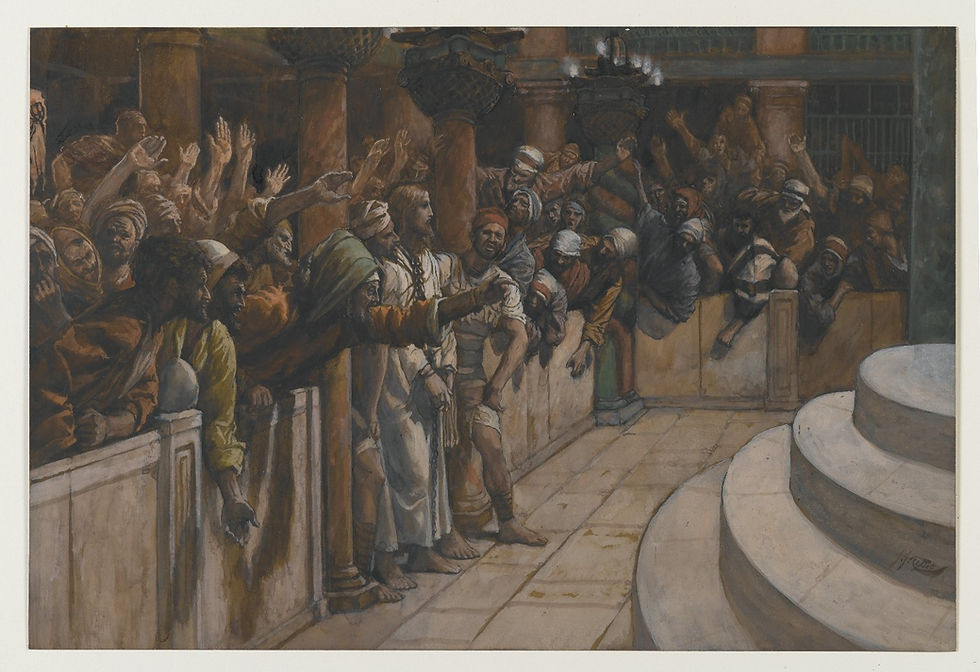
A Note About the Paintings in this Essay
In 1885, a French society painter named James Tissot went into the Church of Saint-Sulpice in Paris to work on a commissioned painting of a woman singing in church. He left a changed man. By his own account, as the Host was raised at Mass, he bowed his head and saw a vision: a worn-out peasant couple sitting in the ruins of a great building, and a figure with pierced hands and feet and a crown of thorns coming toward them, who sat down beside the man and leaned his head on his shoulder, as if to say that he had suffered more than they had, and that without him civilization itself is a ruin.
Tissot painted exactly what he saw. He called it Inner Voices, and it hangs today in the Hermitage Museum in St. Petersburg. Look closely: the old couple do not see who has sat down beside them. It is an oil painting nearly seven feet tall.
Pilate looked Truth in the face, and he walked away. Tissot’s old couple have Him sitting right beside them, and they do not see Him. The truth can be seen by only those with eyes to see.
That experience changed Tissot’s life. For nearly a decade, he painted the stories of the New Testament — 350 of them, in beautiful detail and in miniature.
The painting I chose for this story is titled Jesus Before Pilate, First Interview. It shows Pilate questioning Jesus in private, the conversation in which he asks, “What is truth?” This painting, like the P52 fragment, is physically smaller than its message. Tissot’s series was so widely acclaimed that the people of Brooklyn bought all 350 watercolors by public subscription in 1900 for the Brooklyn Museum. They are rarely on display, because watercolor fades in light, but you can see them online here: https://www.brooklynmuseum.org/search/collection?artist_maker=James+Tissot
Move on to Part 2, “AI and Lies,” when you’re ready to handle more truth. As always, I welcome your comments. Email me at Kathryn@TexasHeritage.net.