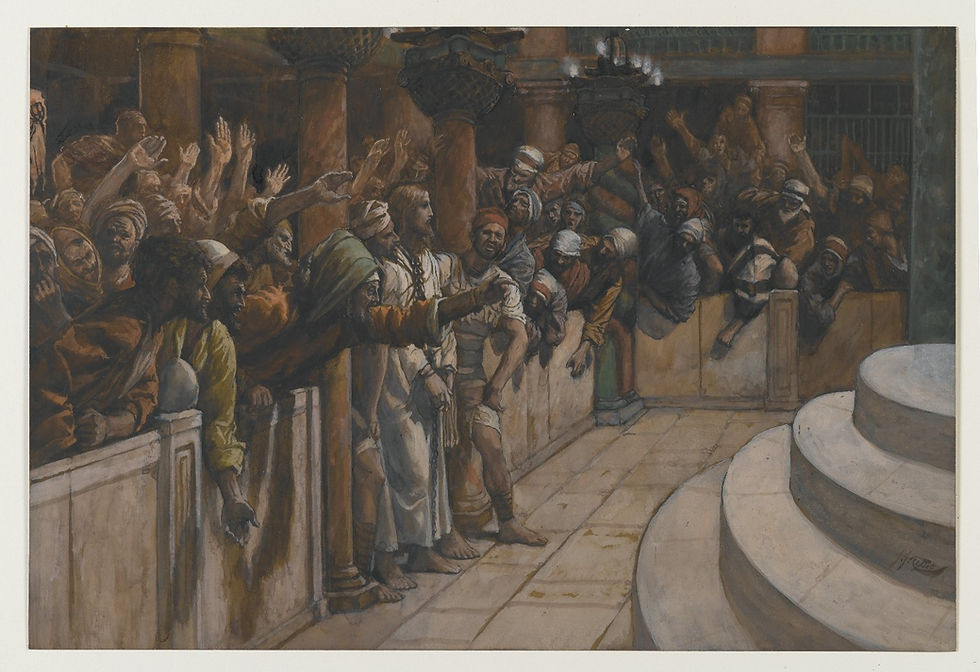
What is Truth? The Story of the Oldest New Testament Fragment

by Kathryn van der Pol

I challenge you to share this story with your doubting Thomas friends.
It’s the story of the oldest surviving New Testament “shard.”
Have you heard of P52?
It is a papyrus fragment. Hence the “P”. It is number 52 because it was the fifty-second fragment ever put on the master list of New Testament manuscripts.
A Biblical fragment is nicknamed “a shard” as if it were a broken piece of pottery.
This amazing story of P52 was popularized by a Bible manuscript expert named Wesley Huff.
P52 is officially called the “P52 Rylands” after the library where it is stored. It is remarkable both for its age and what it preserves.
It dates within twenty-seven years of the autograph, the first edition of the gospel writer John. It was discovered in Egypt, 1678 miles from where the autograph was composed in ancient Ephesus, now in modern Turkey.
The Gospel of John is considered the latest of the four gospels. John, according to tradition, outlived the three other gospel writers, Matthew, Mark, and Luke. Recent discoveries, including P52, have caused scholars to consider earlier dates for the gospel’s composition. Most place this gospel between AD 90 and AD 100, twenty years earlier than when I was taught church history 50 years ago. Some scholars also believe that an Aramaic version had been written as early as 64 to 70 AD.
The date of P52 has major implications. The consensus of experts, according to Huff, is that P52 dates somewhere between 117 and 138 A.D., during the reign of the Roman Emperor Hadrian. This means that from the time John composed it, it took twenty-seven years or less to distribute a copy and deliver it 1700 miles away. This rapid dissemination among Christians occurred just before or during the time that Hadrian destroyed Jerusalem in the Bar Kochba revolt and banned Jews from living in the region.
The fragment is small, yet it’s remarkable for what it preserves as much as its age.
It is written in Greek on both sides of the page. This tells us two important things. First, it was written as a book, not a scroll. Scrolls were rolled and therefore only written on one side. A codex, what we think of as a book, was written on both sides. Christians were among the first to use the codex for literary works.
Second, we can also glean from the fragment the physical size of the book.
Pages of a codex were folded in half and stitched together. This group of folded pages is called a quire. So P52 was a leaf from a larger quire of the Gospel of John. If we had the whole codex, Huff believes it would measure 8.25 inches by 6.3 inches and could have been as many as 576 pages in total.
Side note: Even though papyrus was the most affordable writing material in the ancient world, it was still costly. An even more expensive, much more durable writing material did exist, called parchment, taking its name from the ancient city of Pergamum in Asia Minor. This material was created from the prepared skins of sheep, goats, or calves. Parchment would have been used by governments, especially kings, by Roman nobility, in other words, people of means. The fact that the most ancient manuscripts of the Bible are written on papyrus gives us an important clue that its authors and scribes were not part of the upper class. Papyrus was used by the early church because that was what they could afford. In contrast, the earliest fragments of the Koran were written on parchment, and we know they came from the court of one of the early caliphs. Scholars debate whether the text was standardized during the late 7th or 8th century — decades to over a century after Mohammed died but that's a story for another day.
Huff has also studied the handwriting styles of many of the oldest biblical manuscripts. In his study, he believes P52 was not written by a professional (paid) scribe, but by an educated person. This itself suggests copying the text was a mission, not an occupation. Paid scribes had uniform writing styles that conformed to the region and used standard abbreviations for common words.
Critics of the Bible, your doubting Thomases, often make the argument that you can’t trust the text of the Bible because what we have is a copy of a copy of a copy. And just like the game called telephone, where you whisper something into someone’s ear, and they pass it on to the next person, and so forth, so after it’s repeated multiple times, the result is a garbled version of the original message. They claim that the Bible is just like that.
Well, P52 (and other early manuscripts) toss that analogy into the abyss of lies. P52 is completely consistent with texts of later, more complete manuscripts. In other words, even though this fragment predates other later manuscripts, they match letter for letter the words of this fragment.
You may be asking how we discovered this?
An act of divine providence preserved this manuscript and caused it to be recognized.
Imagine walking into a warehouse that is filled floor to ceiling with boxes, each box not containing books, but storing torn scraps of paper. Then, imagine opening one of those hundreds of boxes and finding a 2.4-inch x 3.5-inch piece of papyrus with Greek writing from the New Testament. Then imagine recognizing those words as coming from the Gospel of John, Chapter 18.
That is how P52 was found.
The “warehouse” was the John Rylands Library at Manchester, England. The discoverer was C. H. Roberts, a graduate research professor at the time at St. John’s College at Oxford. As an expert in Greek papyrology, he recognized the language immediately. He was also struck when he saw the Greek word for “Jew,” quite a clue that he could be dealing with the New Testament. He also recognized the Greek verb “to show.” Then he turned it over and read the Greek for “purpose I was born” and recognized part of the Greek word for “world.”
He would have known it was from the New Testament, but where?
Searching through the Greek New Testament, Roberts found the passage in John 18, and everything fell into place. (Bolded letters represent the words of the preserved fragment.)
…said to him the Jews, “For us it is not lawful
to put to death anyone.” This was to fulfill the word
that Jesus had spoken to show by what kind of
death he was going to die. So Pilate entered his headquarters
again and called Jesus and said to him,
“Are you the King of the Jews?”
This is what happened to Roberts, who was sorting a box of papyrus manuscripts of Greek texts. I have a deep appreciation for the painstaking work of scholars like Roberts — and a personal curiosity about discoveries like this one, having studied paleography in college and worked with medieval and renaissance manuscripts afterward. Roberts dated the handwriting style of P52 to the first half of the second century A.D., making it the oldest New Testament fragment yet discovered.
The text of John 18 is the story of the Jews urging the Romans to crucify Jesus. The last letters of the front of the fragment come from Pilate’s question to Jesus, “Are you the King of the Jews?”
Some text is cut off, but the story continues with Jesus’s answer to Pilate on the back of the fragment. (Bolded text indicates the words on the fragment.)
He explains why he came into the world, “For this purpose I was born”
Why did Jesus come?
He came into the world that I may bear witness to the truth.
Everyone who is of the truth hears my voice.
In other words, Jesus is implicitly challenging Pilate: "Are you of the truth? Do you hear my voice?"
But Pilate doesn’t answer Jesus’s question. He avoids Jesus’s questions, even though we know he is hearing the Voice of Truth.
This is all that Pilate can say:
Pilate says, “What is truth?”
Pilate is speaking like some postmodern atheist. And then, Pilate goes back outside. And our little fragment ends with Pilate’s own judgment, an admission in his final revealing words.
"And this having said again, he went out
To the Jews and says to them;
“I find NO guilt in him.”
Isn’t it remarkable that Pilate finally says ONE TRUE thing about Jesus, how he finds no fault, no flaw, no guilt in him?
Yet, Pilate is unable to recognize Jesus.
While this is where the text of P52 breaks off, the story of Jesus continues in our other manuscripts. The text continues with the story of how Jesus was flogged, beaten, nailed to the cross, crucified, how he died, was buried, and rose again on the third day.
His followers preached the good news, and thousands believed it. And many people copied the gospels that contain the teachings of Jesus, and they produced thousands of manuscripts over time. We have nearly 6,000 manuscripts of the Bible. If you include translations into Latin, Syriac, Coptic, etc., the total exceeds 24,000. There are more copies of the Bible than any writing of the ancient Greek, Roman, or Muslim world.
How remarkable that the oldest shard is quoting Jesus saying, “HE came into the WORLD that HE MAY BEAR WITNESS OF THE TRUTH.”